Grant Sanderson · Essence of Calculus
The Paradox of the Derivative
A derivative measures an instantaneous rate of change — but 'change' needs two moments in time. Grant resolves the paradox by making the gap infinitesimally small rather than zero.
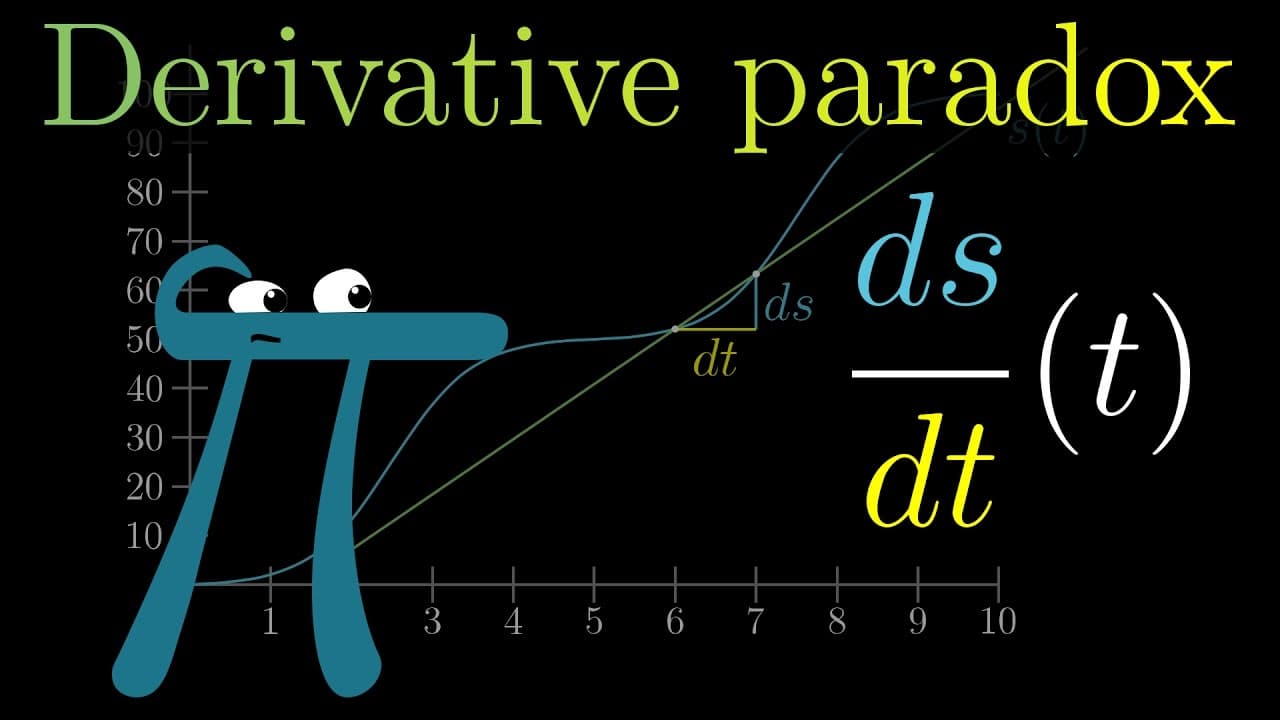 The paradox of the derivative | Chapter 2, Essence of calculus17:07
Formula bank
Derivations
Differentiating s(t) = t³ from first principles
7:50Start from the rise-over-run of a tiny step dt.
↓ Expand the cube
Binomial expansion of (t + dt)³.
↓ Cancel the t³ terms
Only the terms containing dt survive.
↓ Divide every term by dt
Now take the limit as dt → 0.
↓ Drop the vanishing terms
The terms with dt disappear, leaving the exact derivative.
The paradox stated
Speed is distance over time, which needs two points in time. Yet a speedometer shows a speed at a single instant. How can there be a rate of change at one moment, when change requires a before and after?
Set up a concrete example
Let a car's position after t seconds be s(t) = t³. We want its velocity at a specific instant, say t = 2, not its average speed over a long stretch.
- = distance travelled (m)
- = time elapsed (s)
Replace the instant with a tiny interval
Instead of asking for change 'at' t, look at the change over a small window dt and divide by dt. This is an honest rate of change — it just happens over a very short time.
- = a tiny step in time
- = the resulting change in distance
Limit definition of the derivativeWhy dt is never actually zero
If you literally set dt = 0 you get 0/0 — nonsense. The trick is to simplify the expression first, THEN ask what it approaches as dt shrinks. The answer, 3t², is the slope the difference quotient is heading toward.
💡 Pro tip: Read 'dt → 0' as 'as small as you like, but not zero' — that distinction is the whole resolution to the paradox.
The takeaway
The derivative isn't the slope at a single instant; it's the limit of the slope over a tiny interval as that interval shrinks toward (but never reaches) zero.
Go deeper with Clarion
Save this to your Vault to quiz yourself and ask questions across everything you learn.
Coming soon